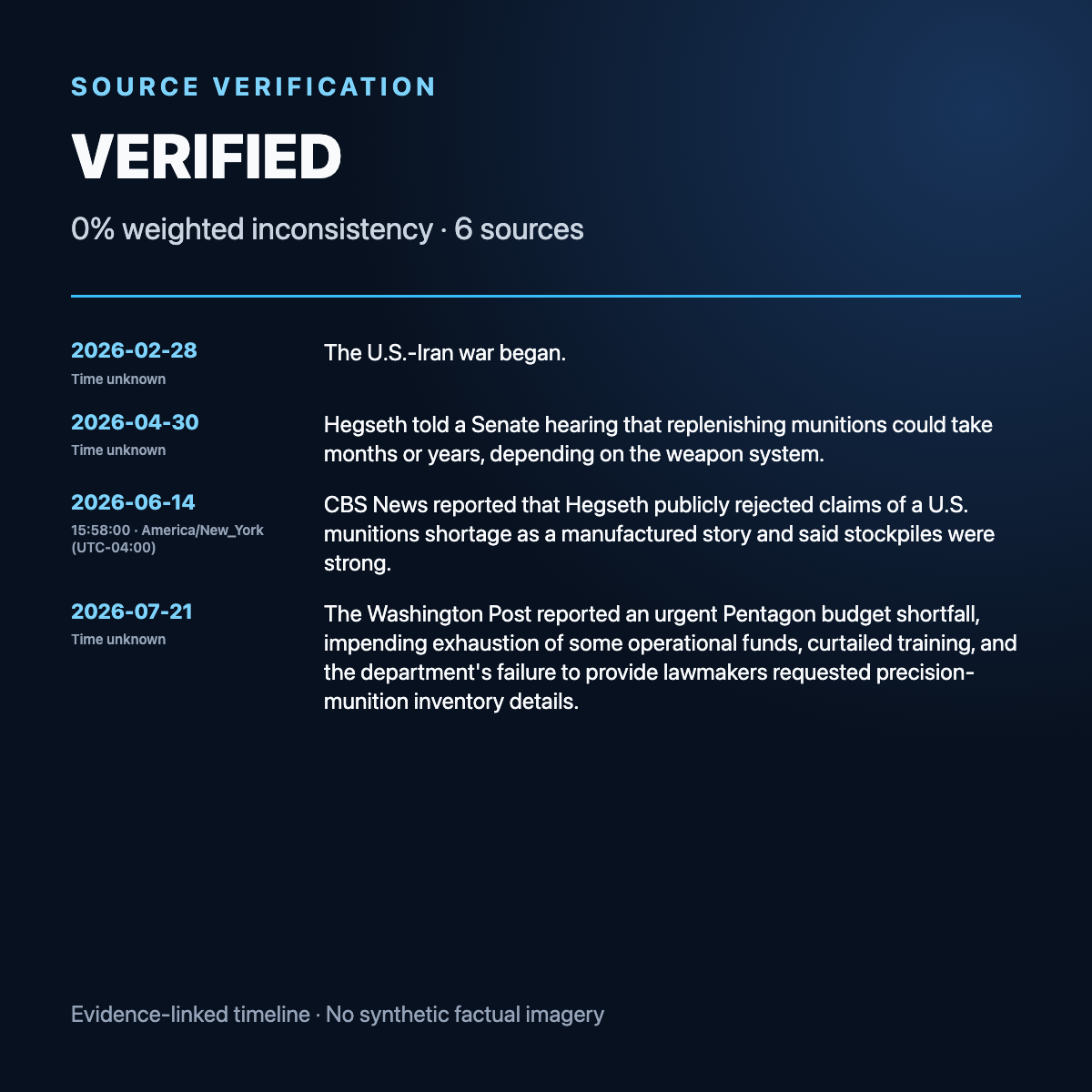
The verdict is verified: two independent reporting families support the central account that long-range U.S. missile stocks were severely depleted during the Iran war while Pentagon officials publicly denied a shortage.[S2][S4]
The Daily Beast reported that officials said strikes had used “virtually all” highly accurate long-range missiles, while The Atlantic separately reported that some remaining supplies were as low as 20 percent of Pentagon objectives and potentially inadequate for an Asian contingency.[S2][S4]
The public account sharply differs: Pentagon spokesperson Sean Parnell called shortage claims false, and Hegseth described the story as manufactured and said stockpiles were strong.[S4][S8]
Funding pressure is independently documented: Hegseth told senators the war had cost $37.5 billion and sought $67.1 billion in supplemental money, before a later private briefing reportedly signaled further requests.[S5][S2]
Replenishment is not immediate, with one expert estimating that some weapons could take five years to restore and Hegseth previously acknowledging that replenishment could take months or years.[S4][S8]
The principal limitation is that the Defense Department has not disclosed how many munitions were used, so the exact “virtually all” formulation cannot be verified from public inventory records.[S8]